MiniMax publicly revealed MiniMax M3.1 Flash on October 19, 2026 — the mystery model that had been serving traffic as anonymous "Space Bunny" on OpenRouter. DeepSeek’s low-cost DeepSeek V4.1 Flash is its closest competitor: both are 1M-context "Flash" tier models priced around $0.15 input. I compared them using official pricing and specs, their published benchmarks, 60 test runs of 10 identical tasks, and an animated SVG pelican test.
The short version
- Same headline price: both charge $0.15/M input and $0.60/M output, but DeepSeek halves rates off-peak and its cache-hit price is five times lower
- Parameters: DeepSeek is larger in total (552B vs 428B) but activates fewer per token (8-16B vs 23B), an architecture built for input-heavy agent workloads
- Weights: DeepSeek ships MIT-licensed weights on Hugging Face; MiniMax says its weights will be released later
- Vendor benchmarks split: DeepSeek wins DeepSWE v1.1 (76.9% vs 73.7%), MiniMax wins AutomationBench v1.0.6 (62.8% vs 60.5%)
- 60 measured runs: no difference in accuracy (30/30 each). The differences show up in output tokens and latency, and they flip direction depending on the task
Specs side by side
| Item | MiniMax M3.1 Flash | DeepSeek V4.1 Flash |
|---|---|---|
| Architecture | MoE with sparse attention and a native visual encoder | MoE with Causal Encoder-Decoder (20-layer encoder + 20-layer decoder) |
| Total parameters | ~428B | 552B backbone (about 763B including all weights) |
| Active parameters | ~23B per token | 8B during prefill / 16B during decode |
| Context | 1M tokens (input and output combined) | 1M tokens |
| Max output | Not published (previous M3 listed 512K) | 384K tokens |
| Inputs | Text, image, video | Text, image |
| Reasoning control | Always on, five effort levels | Thinking on/off plus effort 1-100 |
| Speed | 200+ TPS peak, 170+ TPS at P50 (vendor) | ~180 tok/s (third-party measurement) |
| Weights | Not released; "will be released later" | MIT, available on Hugging Face |
| Training data | Not disclosed | 45T tokens (multimodal) |
Two things stand out:
- Active parameters differ a lot. M3.1 Flash activates ~23B per token; V4.1 Flash activates only 8B while reading and 16B while writing. DeepSeek built V4.1 Flash to keep input processing cheap (KV cache is 890 bytes per token, about one quarter of its predecessor’s)
- Weights availability is opposite. V4.1 Flash is downloadable (510GB, MIT). M3.1 Flash is API-only for now
Pricing
| Item | MiniMax M3.1 Flash | DeepSeek V4.1 Flash (off-peak) | DeepSeek V4.1 Flash (peak) |
|---|---|---|---|
| Input (cache miss) | $0.15/M | $0.15/M | $0.30/M |
| Input (cache hit) | $0.015/M | $0.003/M | $0.006/M |
| Output | $0.60/M | $0.60/M | $1.20/M |
| Concurrency limit | Not published | 2,500 | 2,500 |
- The standard rates are identical ($0.15 / $0.60). The difference is in the details
- Cache-hit input is about five times cheaper on DeepSeek at off-peak ($0.003 vs $0.015). For agents that resend long context every turn, this gap matters
- DeepSeek’s peak hours are 01:00-04:00 and 06:00-10:00 UTC, Monday through Friday (excluding Chinese public holidays). Peak rates are double; everything else, including weekends, is off-peak
- MiniMax M3.1 Flash has no time-of-day pricing. It is half the price of the previous MiniMax M3 ($0.30/$1.20 at 512K input or less)
Vendor-published benchmarks
MiniMax published benchmarks with the October 19 launch, so the vendor numbers can finally be compared. Note that both vendors measured on setups favorable to themselves; these are vendor claims, not neutral measurements.
| Benchmark | MiniMax M3.1 Flash | DeepSeek V4.1 Flash (1017) |
|---|---|---|
| DeepSWE v1.1 | 73.7% (max effort) | 76.9% |
| AutomationBench v1.0.6 | 62.8% (max effort) | 60.5% |
- DeepSeek wins DeepSWE, MiniMax wins AutomationBench, both narrowly
- MiniMax’s footnote states that DeepSeek costs were computed at peak rates (input $0.30, output $1.20, cached input $0.006), so its cost-per-task chart flatters MiniMax. Off-peak operation narrows the gap
- On Agents’ Last Exam, MiniMax reports 29.6% at $111 total cost, positioned as the cheapest on the cost-performance frontier. DeepSeek V4.1 Flash does not appear in that chart (only V4 Pro at 12.6%); DeepSeek’s own published ALE figure is 35.4% under a different harness, so the numbers are not directly comparable
- DeepSeek’s own model card reports Terminal-Bench 2.1 at 90.6 and Terminal-Bench 4.0 at 42.3. Artificial Analysis places V4.1 Flash at 39 on its Intelligence Index (ninth of 120 models)
Measured comparison: 10 tasks, 60 runs
Rather than rely on vendor claims, I ran the same tasks against both models. Prompts were byte-identical and max_tokens was fixed at 16384; reasoning depth was left at each vendor’s default (the effort scales are not interchangeable). Every task was judged mechanically — code executed, JSON parsed, word counts computed — with no human scoring.
| Item | Condition |
|---|---|
| Tasks | Five easy (rotation-matrix function, three word problems, JSON extraction, exact word count, off-by-one bug fix) and five hard (LRU cache implementation, two-bug fix, five simultaneous constraints, SQL generation, aggregation from a 20-row table) |
| Runs | 2026-10-19 UTC, three runs per task per model |
| Routing | DeepSeek via Open-Design; MiniMax via OpenRouter’s free tier |
Results: easy tasks
| Task | DeepSeek | MiniMax |
|---|---|---|
| Rotation-matrix function (executed) | 3/3 | 3/3 |
| Three word problems | 3/3 | 3/3 |
| JSON extraction (parsed) | 3/3 | 3/3 |
| Exact 12-word sentence | 3/3 | 3/3 |
| Bug fix (executed) | 3/3 | 3/3 |
| Total | 15/15 | 15/15 |
No difference, so I raised the difficulty.
Results: hard tasks
| Task | DeepSeek | MiniMax |
|---|---|---|
| LRU cache (OrderedDict forbidden, executed) | 3/3 | 3/3 |
| Two bugs fixed (executed) | 3/3 | 3/3 |
| Five simultaneous constraints | 3/3 | 3/3 |
| SQL generation (run against sqlite3) | 3/3 | 3/3 |
| Top-3 sum from a 20-row table | 3/3 | 3/3 |
| Total | 15/15 | 15/15 |
Still no accuracy gap — but token and latency profiles differ
Every run passed: 60 of 60, zero errors, zero retries. What did differ:
| Task | DeepSeek output tokens | MiniMax output tokens | DeepSeek time | MiniMax time |
|---|---|---|---|---|
| LRU cache | 1,190 | 1,462 | 5.6s | 12.9s |
| Two-bug fix | 125 | 117 | 1.9s | 1.8s |
| Five constraints | 288 | 203 | 2.7s | 2.4s |
| SQL generation | 92 | 47 | 1.7s | 1.1s |
| Long-context sum | 200 | 111 | 2.4s | 1.7s |
| Average | 379 | 388 | 2.85s | 3.99s |
- Long code generation is heavier on MiniMax. For the LRU implementation it emitted ~23% more tokens and took 2.3 times longer (12.9s vs 5.6s)
- Conversely, on SQL and long-context aggregation DeepSeek writes longer reasoning (92 vs 47 and 200 vs 111 output tokens). The advantage flips with task type, so per-task wins do not generalize
- Averages are nearly identical (379 vs 388 output tokens). Which model suits you depends on what you send it
Bonus: the pelican test
The informal benchmark where a model is asked to Generate an SVG of a pelican riding a bicycle, popularized by Simon Willison. Both models got byte-identical prompts and parameters (max_tokens=32768). Both returned static SVGs on the standard prompt, so I re-ran with explicit animation instructions (SMIL, pedaling legs, rotating wheels) and converted 12 frames of each into a GIF.
| Metric | DeepSeek V4.1 Flash | MiniMax M3.1 Flash |
|---|---|---|
| Output tokens (animated) | 17,734 | 23,363 (about 1.3x) |
| Reasoning tokens | 14,358 | 18,900 |
| SVG size | 8,781 chars, 12 SMIL elements | 14,185 chars, 12 SMIL elements |
| Static-prompt tokens | 8,526 | 10,245 |
Side-by-side animation (same 16:9 file used for social posting):
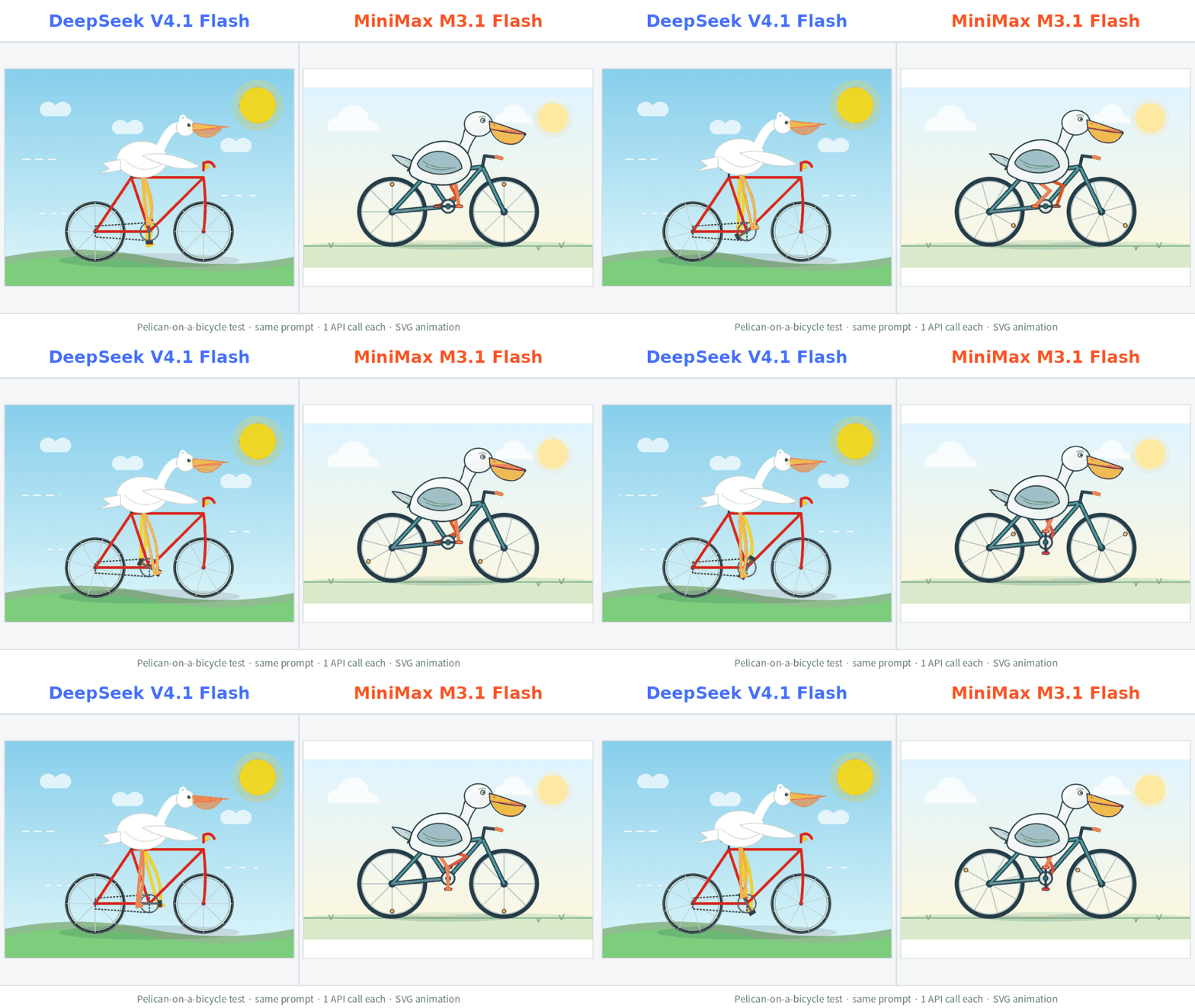
DeepSeek (left) draws a white pelican gripping the handlebars with its wings, plus a sun, clouds and hills. MiniMax (right) produces a flat line-art scene; the legs pedal and the crank turns, but the wings never reach the handlebars. On instruction following in one-shot creative generation, DeepSeek V4.1 Flash is the stronger of the two — though a single run should not be treated as a verdict.
Summary
- Pricing is effectively a tie ($0.15/$0.60) with two exceptions: DeepSeek’s cache-hit price is about five times lower, and only DeepSeek has off-peak discounts
- DeepSeek’s model is larger overall but thinner per token (8-16B active vs 23B), an architecture aimed at input-heavy agents
- Only DeepSeek publishes weights (MIT). MiniMax plans to release them later
- Vendor benchmarks split evenly across the two shared tests, and MiniMax computed DeepSeek’s cost side at peak rates
- 60 measured runs produced zero accuracy differences. MiniMax is heavier on long code generation (2.3x slower), DeepSeek writes more reasoning on SQL and long-context aggregation, and averages are nearly identical

コメント