GLM-5.4 is already available if you pay for GLM Coding Plan.
- It launched on 2026-11-23 and is open to every Coding Plan subscriber
- It adds a 1M-token context window and image input
- It burns 1.5x the quota of GLM-5.3
There is one problem. Z.ai has not published a benchmark table for GLM-5.4. So there is no published number to tell you whether it beats 5.3.
This post measures both models on seven task types and shows where the gap actually is.
Key Takeaways
- Easy work shows zero difference. Code generation scored 167/168 for both; bug fixing scored 84/84 for both
- The gap is on hard problem tasks. GLM-5.3 timed out on all 3 runs of one, even with a 900-second limit; GLM-5.4 finished all 3 in 216-341 seconds
- Long context alone showed no gap. Both models scored 18/18 at 50k, 200k, 500k, and 800k tokens
- Adding a filter changed that. On a filtered aggregation task, 5.3 counted decoys twice out of 21 runs; 5.4 never did
- Cost goes down on normal work. On easy and medium tasks 5.4 uses 0.55x the output tokens, which is 0.83x after the 1.5x quota multiplier. It only gets expensive on hard problem tasks
- The short version: no difference on easy work
- What is new in GLM-5.4
- There is no official benchmark table
- First, confirm it works on Coding Plan
- Method: seven task types, no LLM judge
- Where there was no difference
- Where the gap showed up
- Long context alone showed no gap
- A filtered aggregation did separate them
- Which one to pick
- Cost goes down on normal work
- Summary
The short version: no difference on easy work
We machine-scored 333 cells with no LLM judge. Here is the summary.
| Task type | 5.3 | 5.4 | Gap |
|---|---|---|---|
| Write code from a spec | 167/168 | 167/168 | none |
| Fix a bug | 84/84 | 84/84 | none |
| Fix a bug in a real repo | 12/12 | 12/12 | none |
| Find facts in long text | 72/72 | 72/72 | none |
| Judge code as buggy or correct | 46/48 | 48/48 | small |
| Solve a hard problem task in time | 6/9 | 9/9 | yes |
| Aggregate long text under a filter | 2 false positives | 0 | yes |
The advantage of 5.4 is not general intelligence. It shows up in two places only: staying with a hard problem task, and keeping a condition in mind.
What is new in GLM-5.4
Summary of the official blog post.
| Item | Value |
|---|---|
| Architecture | Loop Transformer |
| Mechanism | Middle 28 layers run twice |
| Parameters | ~750B |
| Context window | 1M tokens |
| Max output | 128K tokens |
| Speed | up to 200 tok/s off-peak |
Running layers twice deepens reasoning without adding parameters. Z.ai claims this reaches "intelligence comparable to 2T-3T models."
There is no official benchmark table
That is where this post started.
| Item | Status |
|---|---|
| Benchmark table for 5.4 | none |
| Published numbers | a 30B ablation only |
| Win rate vs 5.3 | 51.1% win / 25.7% tie / 23.1% loss |
| How that was measured | not disclosed |
| Pay-as-you-go API | not open yet (pending safety review) |
| Model weights | not released |
On the 30B model, AIME25 improved from 19.17 to 30.42. That is not a number for the 750B GLM-5.4. A 51% win rate is also close to a coin flip.
First, confirm it works on Coding Plan
We called the API instead of guessing.
curl -s -X POST https://api.z.ai/api/coding/paas/v4/chat/completions \
  -H "Authorization: Bearer $ZAI_API_KEY" \
  -H "Content-Type: application/json" \
  -d '{"model":"glm-5.4","messages":[{"role":"user","content":"Reply OK"}],"max_tokens":32}'
HTTP/2 200
{"choices":[{"message":{"content":"CODINGPLAN_OK"}}],"model":"glm-5.4"}| Check | Result |
|---|---|
| Listed in the model catalog | yes (created 2026-11-23) |
| Returns inference | yes, 200 |
| Thinking mode works | yes, reasoning is returned |
| Standard pay-as-you-go API | 429, insufficient balance |
| Coding Plan endpoint | 200, success |
The same API key works only on the Coding Plan endpoint. That matches the official note that the Model API is not open yet.
Method: seven task types, no LLM judge
LLM judges introduce position and self-preference bias. We scored every task programmatically instead.
| Axis | What it asks | Scoring |
|---|---|---|
| A | Write code from a spec | 7-8 hidden tests |
| B | Fix a bug given a failing test | 4-5 hidden tests |
| C | Judge a claim as buggy or correct | exact line match |
| E | Solve a hard problem task in time | completion and wall time |
| F | Fix a bug in a real repo | the repo’s own test suite |
| G | Find facts in long text | needle string match |
| G2 | Aggregate long text under a filter | count, sum, max |
Conditions were identical across all axes.
| Setting | Value |
|---|---|
| Thinking level | high, fixed |
| Tools | disabled (enabled on F only) |
| Repetitions | 3 per cell (2 on F) |
| Timeout | 420 seconds |
Where there was no difference
Code generation is a tie
We gave seven specs and scored against hidden tests. The tests cover edge cases, self-loops, and lexicographic ordering.
| Metric | 5.3 | 5.4 |
|---|---|---|
| Score | 167/168 | 167/168 |
| Mean reasoning tokens | 2,783 | 1,533 |
Both are near perfect. Code quality does not separate them.
Bug fixing is a tie
We injected a single-line bug and asked each model to fix it. Both fixed all six cases perfectly.
| Metric | 5.3 | 5.4 |
|---|---|---|
| Score | 84/84 | 84/84 |
| Mean reasoning tokens | 1,412 | 390 |
Real-repo repair is a tie
We injected six test-breaking bugs into tomli, a real TOML parser with 801 lines. Both models ran as agents with read, bash, edit, grep, and find available.
| Metric | 5.3 | 5.4 |
|---|---|---|
| Bugs fixed | 12/12 | 12/12 |
| Tests modified | 0 | 0 |
| Mean turns | 11.2 | 9.3 |
| Mean tool calls | 12.2 | 10.3 |
| Lines changed | 2.0 | 2.0 |
Both were perfect with no test tampering. The only gap is that 5.4 needs fewer steps.
Where the gap showed up
5.3 does not return on hard problem tasks
We gave one hard math problem with a 420-second limit.
| Model | Result | Wall time |
|---|---|---|
| 5.3 | no response, 3 of 3 runs | killed at 420s |
| 5.4 | correct, 3 of 3 runs | 216-341s |
5.3 also failed to return when we raised the limit to 900 seconds. It is not stopping to think; it never finishes.
5.4 follows output format better
We gave each model code plus a claim and asked for a one-line verdict.
| Model | Score | Detail |
|---|---|---|
| 5.3 | 46/48 | correct content, wrong format twice |
| 5.4 | 48/48 | all as specified |
5.3 wrote 判定: where VERDICT: was required. The content was right, so this is really an instruction-retention gap.
Long context alone showed no gap
We scattered five facts through 50k to 800k tokens of text. Token counts come from the API response, not from an estimate.
| Context | 5.3 | 5.4 |
|---|---|---|
| 50k | 18/18 | 18/18 |
| 200k | 18/18 | 18/18 |
| 500k | 18/18 | 18/18 |
| 800k | 18/18 | 18/18 |
Both models found all five facts at every position, including 800k.
Plain retrieval does not separate them.
A filtered aggregation did separate them
Retrieval was saturated, so we required filtering. The document holds 12 genuine invoices and 12 decoys.
| Decoy type | Why it must be excluded |
|---|---|
| REJECTED | not approved |
| DRAFT | not approved |
| USD-denominated | wrong currency |
| INVOICE-ARCHIVE | does not start with the required prefix |
We asked for the count, sum, and max of the qualifying rows only.
| Context | 5.3 | 5.4 |
|---|---|---|
| 100k | 6/6 | 6/6 |
| 500k | 8/9 | 8/8 |
| 800k | 5/6 | 6/6 |
5.3 counted decoys as genuine in 2 of 21 runs. 5.4 never did in 20 runs.
| Context | What 5.3 answered | Reasoning tokens spent |
|---|---|---|
| 500k | count 13, sum 13549 (correct: 12, 12345) | 9,576 |
| 800k | count 13, sum 12904 (correct: 12, 12345) | 23,842 |
In both cases 5.3 dropped the "line must start with INVOICE" condition.
5.4 never dropped it.
The 800k failure spent 23,842 reasoning tokens before answering wrong. Thinking longer did not move it toward the right answer.
Which one to pick
| Use case | Recommendation |
|---|---|
| Everyday coding and fixes | 5.4 (same quality, 17% cheaper) |
| Hard problem tasks | 5.4 (5.3 does not finish) |
| Filtering large document sets | 5.4 |
| Plain long-text retrieval and summary | either (no difference) |
On current data, 5.4 wins more often than not. It matches 5.3 on quality, costs less on normal work, and finishes the hard cases.
Cost goes down on normal work
Your instinct here matters, so we re-cut the numbers by task type. output_tok already includes reasoning tokens, and we confirmed the cost formula matches exactly.
| Task type | 5.3 | 5.4 | Ratio (after 1.5x quota) |
|---|---|---|---|
| A: write code from a spec | 3,062 | 1,799 | 0.59 (0.88) |
| B: fix a bug | 1,523 | 501 | 0.33 (0.49) |
| C: judge a claim | 2,142 | 1,335 | 0.62 (0.93) |
| E: hard problem task | 3,533 | 10,599 | 3.00 (4.50) |
Across A, B, and C combined, 5.3 used 143,131 output tokens and 5.4 used 78,834. That is 0.55x before the quota multiplier and 0.83x after it.
On easy and medium work, GLM-5.4 is about 17% cheaper. It writes shorter reasoning, so it saves more than the 1.5x quota costs.
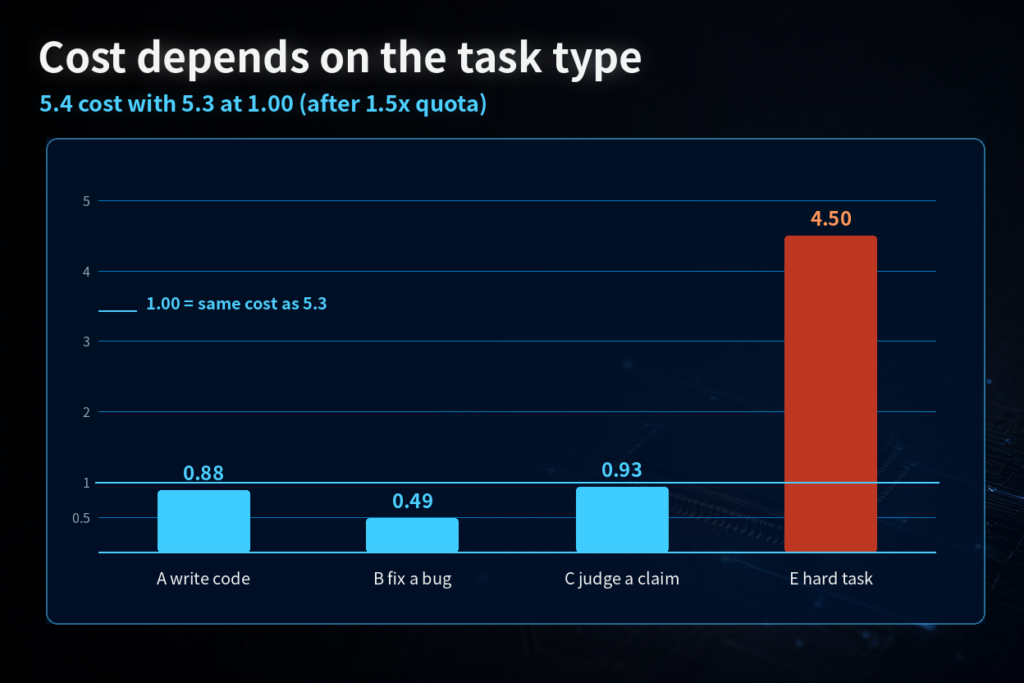
The exception is hard problem tasks, where 5.4 spends about 3x the tokens. But 5.3 did not return at all on those, so the comparison is not really price against price. You are choosing between "expensive and finished" and "cheap and unfinished."
| Item | 5.3 | 5.4 |
|---|---|---|
| Total output tokens, all 72 cells | 164,329 | 174,225 |
| API billing | $0.583 | not published ($0 returned) |
| Coding Plan quota | 1x | 1.5x |
The all-cell totals look similar only because 5.3’s timeouts recorded no tokens. Read the per-task-type table above instead.
Summary
- 5.4 works on Coding Plan today; it is not available on pay-as-you-go
- Easy code generation, bug fixing, and long-text retrieval cannot tell the two apart
- The gap is limited to hard problem tasks and condition-keeping during aggregation
- The "marathon thinking" the vendor warns about showed up on 5.3 in our run, not on 5.4
- Cost is about 0.83x on normal work once you include the 1.5x quota; 5.4 is cheaper there
Each cell ran 3 times, which is not enough to claim statistical significance. Part of the 800k run also hit Z.ai’s usage limit, so those cells are incomplete.
We also hit two rate limits worth recording.
| Error code | Meaning | Impact |
|---|---|---|
| 1302 | request rate limit | appears at 8 parallel workers; stable at 4 |
| 1308 | 5-hour usage limit | half of the 800k cells could not run |

コメント